
The primary economist subject assesses the knowledge of economic subjects and how students are better able to relate these concepts to real life. Many students even find it difficult to handle the primary economist exam, due to the subject complexity and also the subject breadth, which is difficult to cover in a limited time. Some students look for external professional assistance, while others look for helpful strategies through which they can pass economist exam fast.
A focused strategy always helps students to comprehend and interpret difficult ideas, improve efficacy, and manage their time well, which is essential when you are planning to give the primary economist exam. This post will help you go through practical methods that help simplify preparation, improve learning speed, and strengthen understanding of the key concepts required to pass economist exam fast.
Understand the Primary Economist Exam
Before going into any strategy to pass the primary economist, one must be aware of the format and what will come in the exam. If you are not aware of what will come in the exam, how are you going to attempt it? The economist exam structure comprises mainly the following types of questions:
- Multiple-choice questions
- Short-written Answers
- Case Studies based on Analytical Reasoning
The primary economist syllabus revolves around three subjects, which are:
- Microeconomics
- Macroeconomics
- Statistics
Students should have proper comprehension of these subjects, and apart from that, they should have basic policy understanding and data interpretation as well. Students may quickly determine which subjects need more attention and which just need revision when they thoroughly go over the primary economist syllabus.
Many students attempt to increase their scores without knowing economist exam structure, which causes confusion while they are getting ready. Learners can allocate their time effectively and concentrate on high-scoring portions first when they have structured knowledge. This increases precision and lessens needless anxiety when studying for the economics examination.
Focus Only on Economics High-Yield Topics
Instead of attempting to study everything evenly, students should concentrate on economics high-yield topics in order to do well on the test. High-yield themes in economics include GDP, unemployment, inflation, elasticity, and supply and demand analysis. These regions receive high grades and are regularly tested, so students need to have a strong grasp of these sections, and for that reason, they may get help from take my economics exam services.
Building fundamental knowledge is greatly aided by microeconomics, particularly when it comes to subjects like price determination, market equilibrium, and consumer behavior. For a high score, macroeconomic ideas like national income, inflation patterns, and fiscal strategies are equally crucial.
Instead of efficiently revisiting the major economics coursework, many students waste time studying fewer essential theories. This adds pressure during review and decreases efficiency. Students may learn more quickly and remember important ideas more readily by concentrating on economics high-yield topics. A targeted strategy guarantees improved readiness and enables students to swiftly study crucial topics without needless overburden.
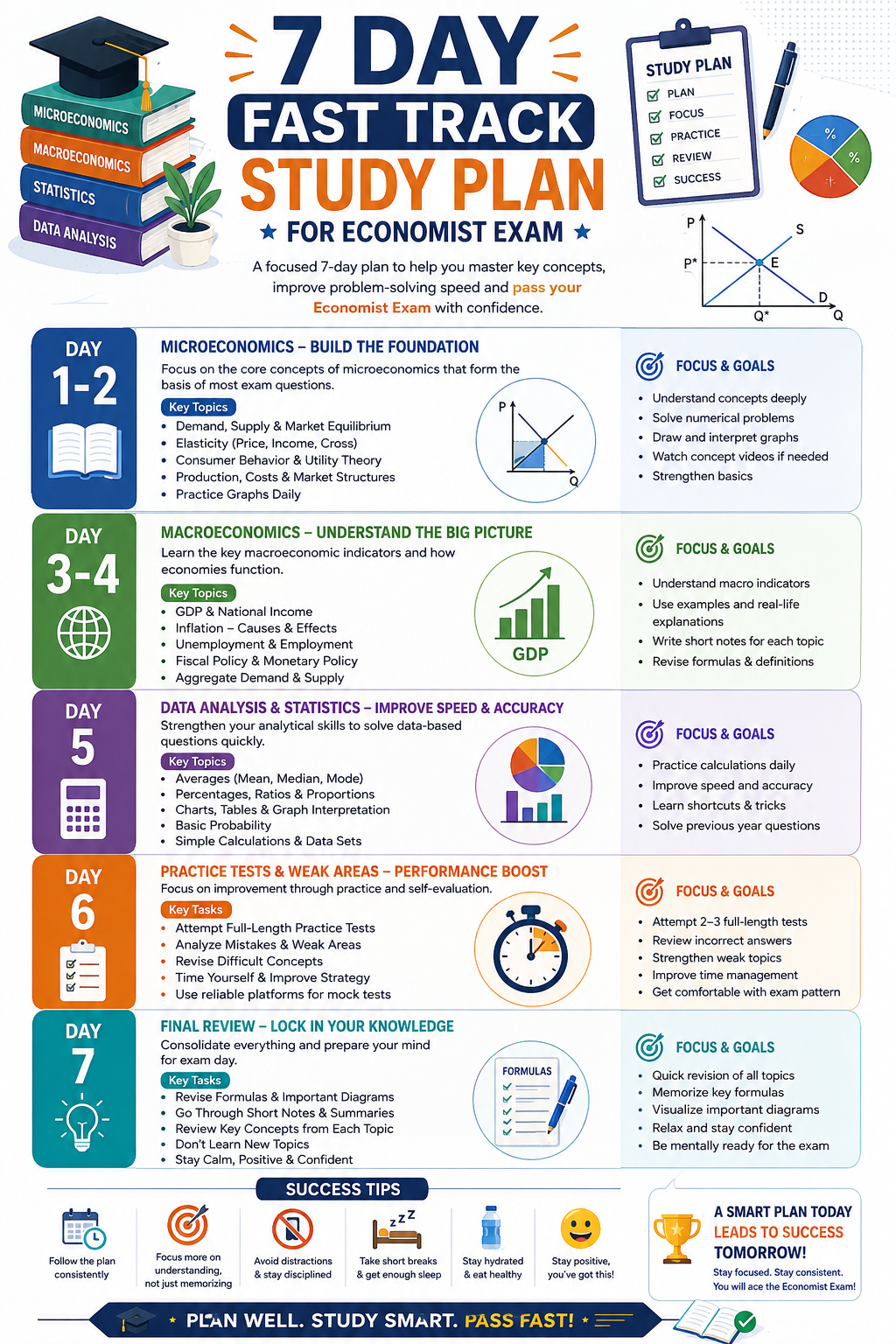
7 Day Fast Track Study Plan
A well-organized study schedule for economics exams helps students to become ready fast without being distracted. By breaking out the material into daily goals, the economist exam study plan makes review easier and more structured.
An easy 7 Day fast-track study plan referred from a reliable take my economics exam for me service is:
Day 1-2
The first two days are devoted to the fundamental ideas of microeconomics. Demand, supply, elasticity, and fundamental consumer theory should all be studied by students. In order to increase comprehension and accuracy while answering problems, they should also practice graphs on a regular basis. If students feel any difficulty in understanding these difficult concepts, they may get help from online lectures provided by Do My Exam for Me like services.
Day 3-4
The fundamentals of macroeconomics are covered on days three and four. GDP, inflation, unemployment, and national income are important subjects. To increase clarity, these ideas need to be explained with brief comments and repeated explanations.
Day 5
Data analysis and statistics are the focus of day five. Averages, charts, and simple computations should be practiced by students. This phase decreases exam question mistakes and increases analytical speed.
Day 6
Day 6 is devoted to weak areas and practice exams. Students should review challenging material, evaluate their work, and actively attempt practice exams on reliable sites. This way, they get to know the type of questions that may come in the exam, and are better exposed to the exam environment, which helps them better manage their time.
Day 7
Formulas and important diagrams are finalized on day seven. The economist exam study plan is completed, and the mind is ready for memory under pressure with a brief review of all the important subjects.
Use Active Recall to Study Faster
One of the best strategies for enhancing comprehension and memory is active recall economics. Instead of just reading notes over and over again, active recall economics emphasizes self-testing. This method improves long-term memory by making the brain recover information.
Students may use this approach through flashcards, self-reflection, and brief tests. Closing notes and remembering important details after studying a subject greatly enhances retention. A lot of pupils read passively, which frequently causes them to lose ideas rapidly. This issue is resolved by active recall economics, which increases recall accuracy and speed.
Practice Past Papers & Mock Exams
To comprehend actual test patterns, it is crucial to practice economics past papers. When you search pay someone to take my online economics exam for me, you can get a wide range of services that provide updated past papers for the economics exam. Students can uncover recurring question types, frequently tested subjects, and marking trends by looking at previous economics papers.
Additionally, the mock exams economics help in simulating actual exam settings. They enhance time management, accuracy, and speed. Additionally, they assist pupils in acclimating to stressful conditions before the real test. Frequent practice lowers exam anxiety and boosts confidence. Students who regularly solve economics past papers do better, because they are familiar with the question structures. Additionally, it speeds up problem-solving.
Better preparation for the final exam is ensured by the combination of mock exams economics, and past papers.
Memorize Key Formulas & Graphs
Accurately answering numerical problems requires an understanding of economics formulas. GDP, inflation rate, and elasticity equations are examples of economic formulae. The test makes frequent use of these formulae, which need to be updated on a regular basis. There are many reliable test-taking services out there that provide students with easy formulas that can help them solve lengthy questions in minutes.
For visual comprehension, graphs like supply and demand curves are also crucial. These graphical questions, which frequently appear in various formats on the examination, assess interpretation abilities. To increase memory speed, students should write economics formulas and graphs on a daily basis.
Time Management During the Exam
Managing your exam time well is crucial to finishing the paper effectively. Exam time management enables students to effectively distribute their time across all parts. To gain confidence, students should start with simple questions and store more challenging ones for later. Initially, avoiding difficult inquiries saves time and eases tension. Time should be allocated in accordance with the allocation of marks.
Exam time management skills are improved with consistent practice. After learning how long each question takes, students make the necessary adjustments.
Common Mistakes That Could Slow You Down
Even with adequate study, economist exam mistakes frequently lower student success. One typical error is concentrating too much on unimportant subjects rather than crucial ones. Ignoring practice exams and depending solely on reading is another error.
Additionally, a lot of students forget important ideas during tests and neglect to thoroughly review. Another significant problem that has an impact on outcomes is poor time management during preparation.
Instead of using organized study techniques, some students experiment with shortcuts, which does not enhance comprehension. Students can stay focused and do better overall by avoiding economist exam mistakes.
Quick Resources to Speed Up Preparation
Economics study resources are crucial for efficient and timely revision. Study materials for economics include brief notes, video lectures, and summary sheets that make difficult subjects easier to understand. Services such as take my exam for me may also help by providing easy revision notes and practice papers.
Before tests, students can swiftly review with the use of brief notes. Concepts are explained simply and visually in video lectures. Key definitions and formulae are easily accessible through summary sheets.
Time is saved, and comprehension is enhanced by using economics study materials. When time is of the essence during the last phases of review, these economics study resources are very helpful.
Conclusion
Success in the exam requires consistency and disciplined execution. Students should focus on high-yield topics and prepare strategically instead of cramming all things together. Practice exams are the best buddy for those who are not finding a proper direction for studying and struggle with managing time as well.
Accuracy and speed are crucial throughout the test, and if students stick to the plan, concentrated effort with specific daily targets can greatly increase performance. During preparation, stay away from distractions and maintain a rigorous study schedule. Clarity and direction may be developed by using a solid study strategy for the economist test. You may pass economist exam fast and with confidence if you take action early.