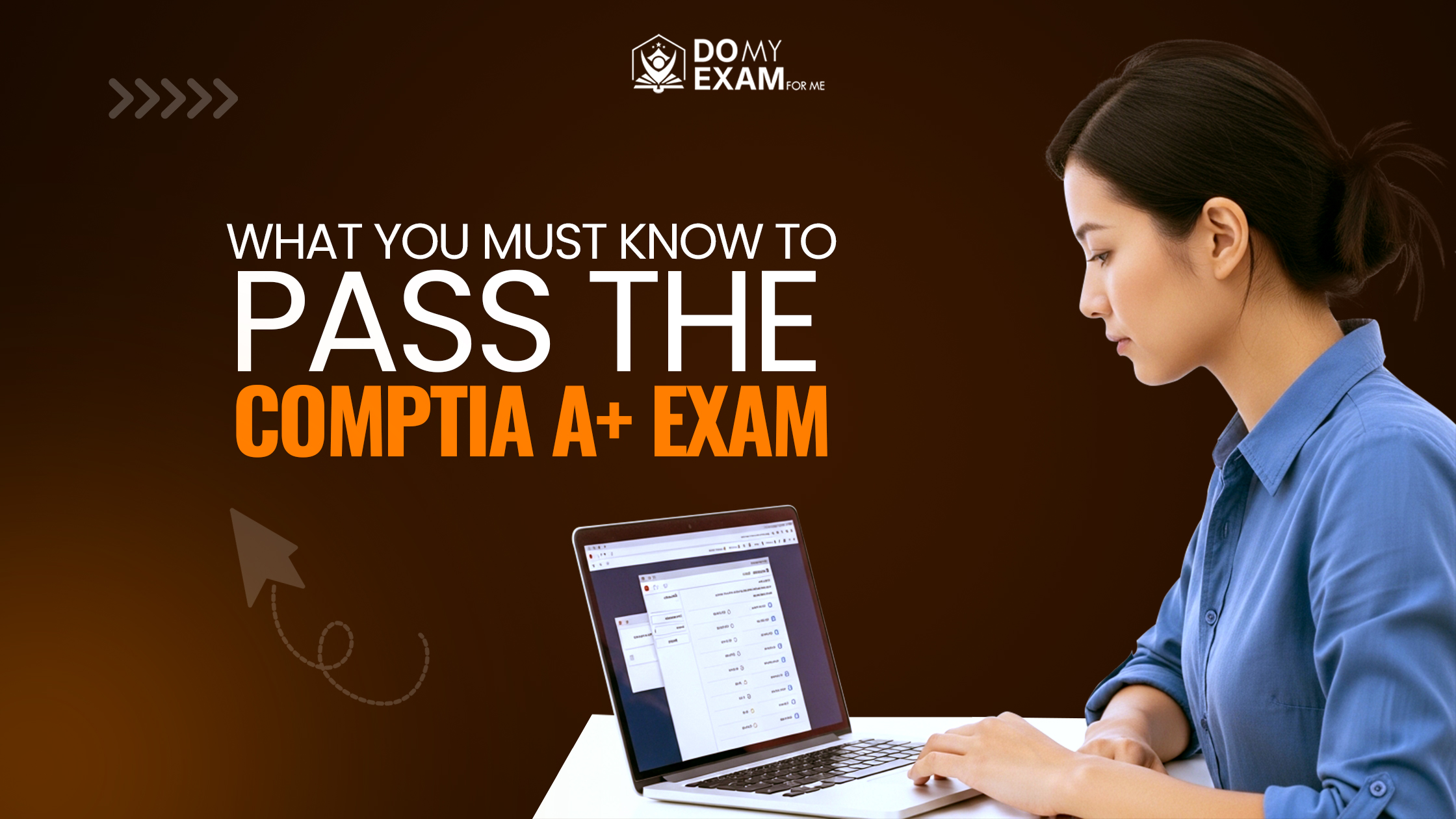
The question of how to pass CompTIA A+ is a topical issue among novices entering the world of IT nowadays. This certification confirms basic technical skills needed in low-level jobs. It discusses hardware, software, networking, and security basics. This is because many candidates do not succeed because of poor planning and weak knowledge of exam objectives. It is based on systematic study, a clear understanding of concepts, and consistent practice.
This is a guide of what you have to know by the time you actually get to the exam day. It divides complicated issues into easy explanations. You will know what, how, and how not to study.
In cases where the students are completely stuck and feel that they have done their best, they can consult an expert. Some learners seek support by searching “take my CompTIA exam for me” when they require the professional assistance of taking exams on their behalf and receiving good grades.
How to Pass CompTIA A+ by Understanding the Exam Format
To be certified as a CompTIA A+ holder, one has to pass two exams. These exams are Core 1 and Core 2. Every exam has a variety of technical skills. They both have performance-based and multiple-choice questions. Each exam will take ninety minutes. Time management is highly essential.
The questions might seem baffling at first sight. The majority of them are based on simple ideas and reasoning. Mistakes may be avoided by reading. Questions based on performance are presented in the first place. They are usually more time-consuming.
Other students also resort to the service of a CompTIA exam helper when they find it cumbersome to prepare and need someone to take their exam.
Exam Scoring and Question Types
The scoring scale ranges from one hundred to nine hundred. A passing score is required for both exams. Not all questions carry equal weight. Performance-based questions often matter more.
Question formats include:
- Multiple choice with one or more answers
- Drag and drop matching
- Scenario-based simulations
Understanding formats improves confidence during testing.
Core Technical Areas You Must Know
The exam objectives define all the topics that are examined. It is well to adhere to them. Core 1 is concentrated on hardware, networking, and mobile devices. Core 2 deals with operating systems, security, and troubleshooting. Neglecting goals will bring about failure.
Domain weights should be noticed by every CompTIA test taker. The percentage is assigned to each section and therefore, spend more time in the weight areas.
Hardware Fundamentals Explained Clearly
Hardware questions: Knowledge of computer parts. You have to recognise processing units, memory, disk, and motherboard. Get to know the interaction of components in the functioning of the system. Know the rules of compatibility of upgrades. You have to be familiar with ports and connectors as well. Get to know about USB versions, display connector and power cables. Hardware troubleshooting is a common occurrence.
Mobile Devices and Laptops
Mobile device topics include smartphones, tablets, and laptops. Learn common hardware features and limitations. Understand screen types and battery technologies. Know basic repair and replacement procedures. Questions often test practical troubleshooting. You must choose logical steps. Memorization alone does not help here.
Networking Concepts You Need to Understand
The concepts of networking are extensively found in Core 1. You have to know the fundamentals of the network. Understand the stark dissimilarities between LAN, WAN, and PAN. Know of wired and wireless networks.
Networking Protocols and Ports
You must be aware of general procedures and their use. Learn HTTP, HTTPS, FTP, and SMTP. See the reason why secure protocols are important. Know fundamental port numbers. IP addressing is in a basic form. Concentrate on recognition, but not computation. The questions test the functionality and not the mathematics.
Network Devices and Their Functions
Learn the roles of routers, switches, hubs, and access points. Understand device placement and basic configuration. Knowing devices improves troubleshooting questions and scenario-based problem-solving on the exam.
Operating System Knowledge That Matters Most
The content of Core 2 is dominated by operating systems. Topics about windows are most prevalent. Master Windows installation technique and system requirements. Know upgrade paths and recovery paths. Be familiar with command-line utilities. Learn when to use them.
macOS and Linux Awareness
The test consists of macOS and Linux fundamentals. They are not supposed to be mastered by you. Master general characteristics and file systems. Know the user permissions and updates. The ability to identify system differences is useful in answering comparative questions.
System Maintenance and Updates
Understand OS maintenance tasks like updates, patches, and disk management. Regular updates prevent errors. Knowing backup, restore, and recovery processes improves troubleshooting performance and scenario-based exam answers.
Security Concepts You Cannot Skip
In both exams, security is presented. You are to be familiar with popular threats. Some of the important issues are malware, phishing, and social engineering. Get to know the way in which attacks take place and the methods of avoiding them.
Wireless and Data Security Basics
Know secure wireless standards. Understand the basics of encryption and its reasons. Be aware of typical security good practices. There are judgment questions based on scenarios. Select the surest and most feasible route.
Common Threat Recognition
Identify common attack types like ransomware, viruses, and trojans. Learn their signs and typical targets. Recognizing threats quickly helps prevent damage and strengthens both exam answers and real-world IT skills.
Implementing Security Measures
Use user-security mechanisms such as using multi-factor authentication, firewalls, and using secure passwords. Data are secured by physical and network controls. Knowledge of viable security solutions would enhance national performance and preparedness for the examination in terms of scenario questions.
Troubleshooting Skills Are Essential
Troubleshooting questions are also the questions that are used to test your thinking process. CompTIA has a specified troubleshooting process. You have to learn and use it properly. The order of steps matters. It is always best to identify the problem beforehand. Never jump to solutions.
Understanding the CompTIA Troubleshooting Methodology
The question of troubleshooting is a test of thought. CompTIA has its troubleshooting methodology. Every step has to be memorized and used properly. The order of steps matters. First, find out what the problem is. Never jump to solutions.
Applying Troubleshooting Scenarios
Questions often ask for the next best step. Read scenarios carefully. Avoid skipping steps. Logical thinking earns points. Practice troubleshooting regularly to build confidence.
How to Study for CompTIA A+ Effectively
The question of how to study for CompTIA A+ is based on consistency. Start with exam objectives. Construct an effective plan of study. Long cramming sessions are not as effective as short sessions every day. Use multiple study methods. Integrate reading, videos, and practical work. Learning involves taking action, which enhances retention.
Using a CompTIA A+ Study Guide
The CompTIA A+ study guide assists in content organization. Select a revised guide that is in agreement with current exam codes. Read effectively and make notes. Review weak areas more often. Ports and commands in a flashcard. The more a thing is repeated, the better the memory becomes.
Diversifying Study Methods
Combine videos, hands-on labs, and flashcards for better retention. Explaining concepts aloud reinforces memory. Practice multiple question types. This approach strengthens understanding and prepares you for varied exam scenarios.
Practicing with CompTIA Study Questions
CompTIA study questions can be used to analyze readiness. Apply them at the end of studying each topic. Avoid guessing blindly. Take practice exams seriously. Go through explanations. Learn to know why responses are right or wrong. This creates understanding on a greater level.
Performance-Based Question Practice
Simulated tasks are performance-based questions. Work in the laboratories where possible. Get familiar with the command-line. Consider carefully what is in the instructions to be followed during the exam. Partial credit is possible. Always attempt every task.
Reviewing Incorrect Answers
Analyze every wrong answer carefully. Identify gaps in your knowledge. Focus study on weak areas. Repeat questions until correct. Understanding mistakes improves retention and strengthens exam readiness significantly.
Time Management Practice
Practice questions: Simulate exam time. Set some particular minutes on a section. It is not advisable to hurry or waste time on a single problem. This develops momentum and confidence for the test day.
Common Mistakes That Lead to Failure
Avoidable errors normally cause many candidates to fail the CompTIA A+ exam. These mistakes are usually as an outcome of poor study and poor planning. It is better to understand them early, before you are likely to succeed.
- Ignoring official exam objectives and studying random or outdated topics
- Relying only on videos without reading a CompTIA A+ study guide for structure
- Skipping hands-on practice and performance-based question preparation
- Studying inconsistently and cramming close to exam day
- Memorizing answers instead of understanding core concepts
- Not reviewing incorrect practice questions carefully
- Panicking when questions seem unfamiliar or worded differently
Conclusion
To become a CompTIA A+ holder, one has to be smartly prepared and hardworking. Development of concentration on the exam intentions and essential concepts. Be in practice, and think rationally. Learn systems rather than learn facts. Through being disciplined and having the correct strategy, one can be successful. This certification lays a good foundation for an IT career. Be regular, be concentrated, and take the exam confidently.